
1 Requirements
General requirements
(1) Papers should be innovative, academic, accurate, conformity to standards, and readable.
(2) Research papers at the forefront of their disciplines will be given priority for publication. Submissions must highlight key points, have clear arguments, be well-organized, rely on dependable data, and be concisely written.
(3) Submissions must not be duplicated across multiple journals. The author registration form (downloaded from the Download Center) should be uploaded along with the article to the submission system.
(4) The paper must include: ① title of the paper; ② author’s name and affiliation; ③ abstract; ④ keywords; ⑤ Chinese library classification (CLC) number; ⑥ main text; ⑦ conclusion; ⑧ references. On the footer of the first page of the manuscript, indicate the research project that funded the paper, the project number, and the corresponding author, etc.
Detail requirements
(1) The title of the article should be concise and smooth, generally containing 10 to 15 content words, avoiding the use of non-public abbreviations, codes, etc.
(2) The format for author names is required as follows: LI Donghua1, WANG Hao2, with corresponding numerical superscripts next to each author’s name to indicate their affiliations. The affiliation format should include: Department (or School), University, City, Postal Code, Country, such as: College of Mechanical Engineering, Donghua University, Shanghai 201620, China.
(3) The abstract of the paper should be written as an informative abstract, including four parts: purpose, methods, results, and conclusions, with a word count of around 200 words. The abstract should not be divided into sections, should be self-contained, written in the third person. References, figures, tables, and formulas from the text must not be cited, meaning that the numbers or identifiers for references, figures, tables, or formulas should not appear.
(4) The selection of keywords should be accurate and standardized, reflecting the main content of the article, with 4 to 8 keywords. Overly broad concepts and plural forms should be avoided.
(5) Please refer to the official Chinese Library Classification (CLC) system for the appropriate CLC number. You can access the system through the following link: https://www.clcindex.com/category/.
(6) The main body of the text should be structured with clear, descriptive headings such as Introduction, Materials and Methods, Results and Discussion, and Conclusions. Subsections should be numbered 1.1 (then 1.1.1, 1.1.2, ...), 1.2, etc. (the abstract is not included in section numbering).
(7) The variable symbols in the article are in italics, while matrices and vectors are in bold italics. Variable symbols are represented by single letters and can have subscripts; there is no limit to the number of the subscripts. If the subscript represents a variable, it should be in italics; if it is an abbreviation of a word, it should be in the regular body. For example, the y-component Fy of the force, where y is the coordinate axis symbol and the subscript y is italicized. The magnetic resistance Rm, m is the abbreviation for magnetic, where the subscript m is in the regular body.
(8) The three-line table is recommended, presented as editable text rather than images. The image must be of sufficient quality to ensure that all details are clearly visible when printed on A4 paper. If there are physical quantities and units in the header of the table and figure, the form of “physical quantity or physical quantity symbol/unit”. Charts and figures should be placed appropriately within the text, referred to as Table 1 and Fig. 1, etc., with the requirement that text precedes the corresponding table or figure. Content shown in tables should not be repeated in figures; the same applies in reverse. Titles for tables and figures should be concise, minimizing the use of articles. For the same physical quantity data, the number of decimal places must be consistent throughout the text.
(9) References should be closely related to the content of the article. Please ensure that every reference cited in the text is also present in the reference list (and vice versa). In the text, cited references should be indicated by numbers in square brackets, following the order in which they are mentioned. The cited references should be the latest academic papers, books, conference papers, technical reports, patent literature, dissertations, etc. and have been officially published at home and abroad. Unofficially published literature cannot be cited.
The referencing format for the bibliography included in the paper is as follows:
(1) Journal article: [Number] Author(s). Title[J]. Journal name, year of publication, volume(issue): starting page - ending page.
(2) (In some journals, the layout is arranged according to reference numbering. For these types of references, use the reference numbers instead of page numbers.)
(3) Book: [Number] Author(s). Book title[M]. Edition (do not write for the first edition), publisher, place of publication, year of publication: starting page - ending page.
(4) Conference paper: [Number] Author(s). Paper title[C]//Conference name, conference location. City of publisher: Publisher, year: starting page - ending page.
(5) Patent document: [Number] Patent applicant or owner. Patent title: Country, Patent number[P]. Date of announcement or publication.
(6) Dissertation: [Number] Author. Thesis title[D]. Location: Institution name, year.
(7) International or national standards: [Number] Standard number, Standard name[S]. Place of publication: Publisher, year.
(8) Electronic document: [Number] Author(s). Title of electronic document[Type of electronic document/Identifier]. (Date of publication or update)[Access date]. Source or URL of the electronic document.
Notes
(a) If the reference is in Chinese, it must be translated into English and followed by (in Chinese), ensuring that the translation is accurate, especially for journal names and publisher names. Generally, Chinese documents provide English titles, and Chinese journals have official translations; please use the original English titles and official translations of journal names.
(b) Identifiers for electronic resources:
· Monograph: [M/OL]
· Journal: [J/OL]
· Electronic bulletin: [EB/OL]
· Conference proceedings: [C/OL]
· Computer program: [CP/OL].
The paper template is provided under these requirements (seen in Download Center).
2 Review Process
This journal adheres to a double anonymous peer review process and a rigorous three-stage review and three-stage proofreading system for finalizing manuscripts. Typically, from the date of receipt, the average review cycle is 7 weeks, and the average publication cycle is 38 weeks. If you have not received the review results of your manuscript after the expected time, please inquire with the editorial office promptly. The review process for manuscripts is as follows:
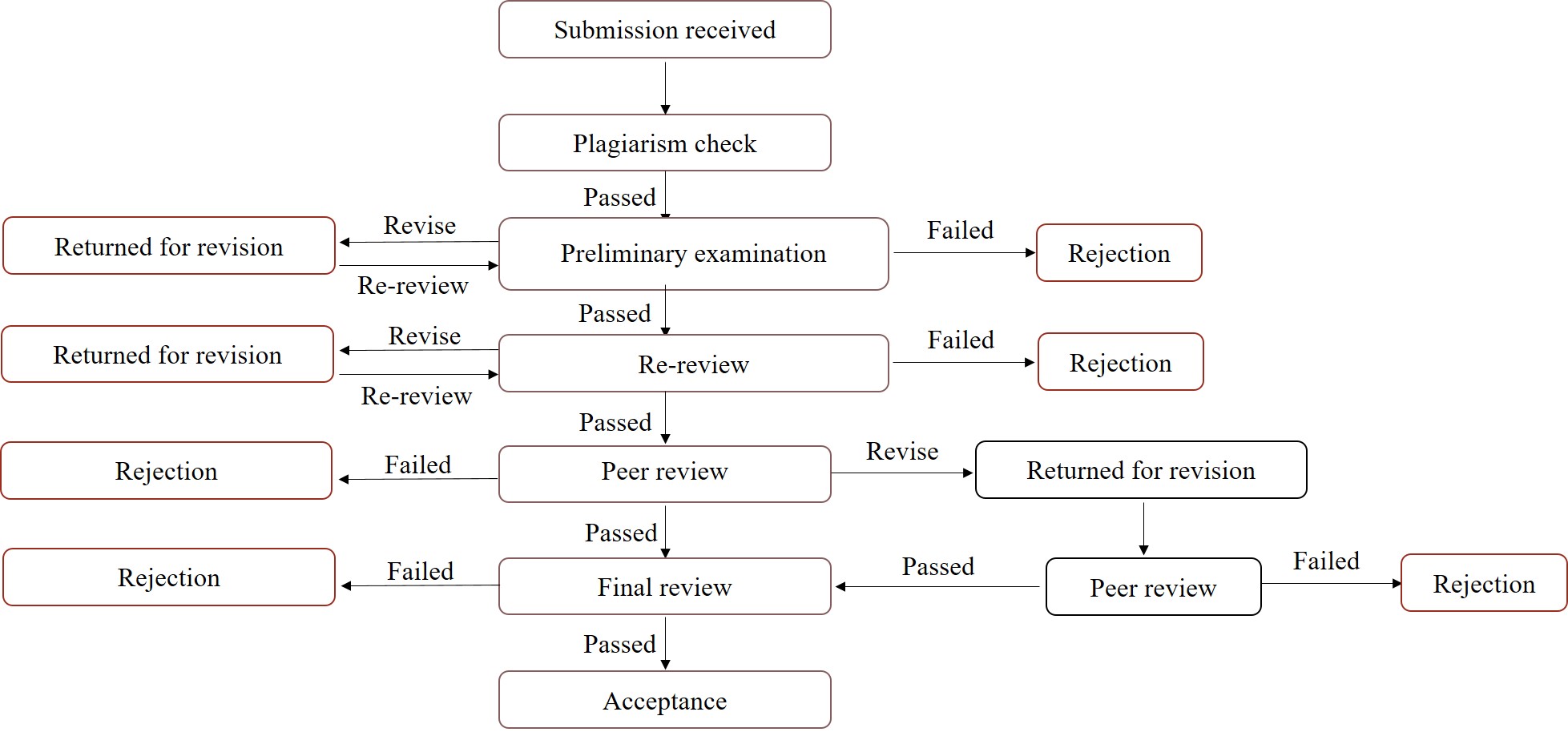
Explanation of Key Review Steps
(1) Initial Review
The editorial team conducts a preliminary review, mainly to check if the manuscript falls within the scope of the journal's disciplines and if it adheres to the basic formatting requirements. This process usually takes 1 to 3 working days.
(2) Secondary Review
The editorial department invites editorial board members from relevant disciplines to review the manuscript according to its research direction, focusing on the innovation of the research and the rationality of the experiments.
(3) Peer Review
At least two external reviewers conduct the double anonymous peer review. If there is a disagreement among the reviewers' opinions, the manuscript will be sent to additional experts for review. The editorial department will send the final review comments to the authors, who are required to respond to each comment and submit a revised version of the manuscript.
(4) Final Review
The editor-in-chief conducts the final review, taking into account the external reviewers’ opinions to give the ultimate decision (accept, accept with revisions, resubmit after revision, reject).
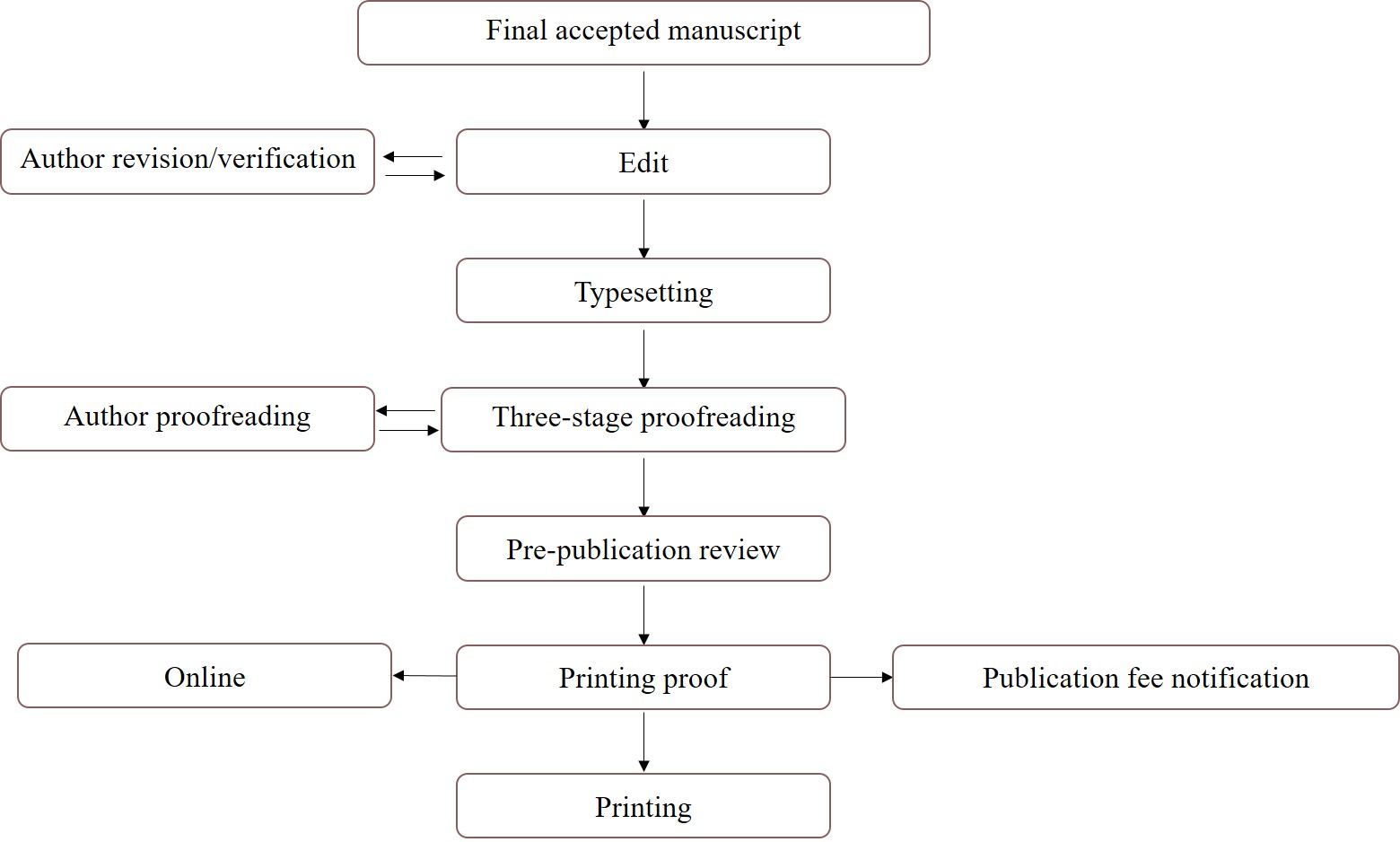
Once the manuscript is accepted, it proceeds to the editing and proofreading stage.
3 Statement of Competing Interests
Journal of Donghua University (English Edition), in compliance with the guidance of the Committee of Publishing Ethics (COPE), asks the authors to disclose all relationships/activities/interests listed below that are related to the content of your manuscript. “Related” means any relation with for-profit or not-for-profit third parties whose interests may be affected by the content of the manuscript. Disclosure represents a commitment to transparency and does not necessarily indicate a bias. If you are in doubt about whether to disclose a relationship/activity/interest, it is preferable that you do so.
(1) All financial support for authors and their institutes from any institute or company at any time.
(2) Non-financial support for the present manuscript from any institute or company such as research design, data collection, data analysis, provision of materials or equipment, provision of software, medical writing and polishing and so on.
(3) Possessing stocks, having consultancy or other employment relationship or receiving any payment from a company such as honoraria, travel support, gift and so on.
(4) Common interest with a company such as patents and loyalties.
(5) Any other competing interests which may impair the credibility of the manuscript.
4 Statement of Authors Contribution
Those who are named as authors should directly participate in the conception or design of the academic content of the article, the research work or the writing work. The order shall be determined before submission and shall not be changed thereafter. If truly necessary, the order could be changed if a consent letter signed by all authors is provided. Other contributors of the paper may be listed in acknowledgement. “Gift author” is strictly prohibited.
5 Copyright License Agreement
Grant of License
All authors agree that once the article is accepted, the authors will license the entire article, any part of the article, and related content (such as research questions, research ideas, methods, processes, data, detailed information on results, including theoretical derivation and experimental processes) or all other rights that can be extracted from the article for reproduction and dissemination, including but not limited to reproduction rights, distribution rights, information network dissemination rights, broadcasting rights, performance rights, translation rights, compilation rights, adaptation rights, and other copyright property rights, to the editorial department of JDHUE for use. The editorial department of JDHUE has the right to use them in the following ways, including but not limited to:
(1) Reproducing, distributing, disseminating through information networks, broadcasting, or other means of communication in all known or future forms, formats, and media, such as CDs, disks, and the internet;
(2) Translating, adapting, compiling the paper, and using any figures, abstracts, or any part of the paper to create derivative works;
(3) In addition to the editorial department of JDHUE own use, the editorial department of JDHUE has the right to license third-party platforms (including China National Knowledge Infrastructure) to exercise the aforementioned rights.
Term of License
The duration of copyright protection.
Scope of License
Global.
Intellectual Property Commitment
The author guarantees that the article is an original work and does not involve academic misconduct, such as confidentiality or multiple submissions. If any infringement or disclosure occurs, the authors shall bear all responsibilities.
Services for Authors
This journal and related licensing platforms provide services to authors to assist them in their scientific research, learning, creation, and publication. The specific services are subject to the announcements on the third-party platforms.
Author Rights
By signing this agreement, all authors agree to abide by the Creative Commons License. After open access to the article, the author has all the rights granted by CC BY.
About Publication
The author agrees to submit this article (including all data such as Chinese and English abstracts and appendices) to the editorial department of JDHUE for publication in both paper and online preprint versions. The author also agrees to the editorial department’s necessary review, editing, and modification of the article and agrees to the pricing set by the editorial department of JDHUE for the payment to the author (including copyright transfer fees) and the article processing charges to be paid by the author.
About Dispute
Any disputes arising from the performance of this agreement by both parties shall be resolved through negotiation. If negotiation fails, either party may bring a lawsuit to the People’s Court with jurisdiction over the location of the editorial department of JDHUE.
Validity and Termination of Agreement
This agreement shall take effect upon the consent of the author. If the submitted article is not accepted, this agreement shall automatically become void.